Influencer Payment Workflows: How Brands Eliminate Delays and Disputes
Manual influencer payment workflows create delays and disputes. Learn how brands automate influencer payments, use escrow securely, and scale campaigns without operational friction.
February 13, 2026
Influencer marketing has matured into a serious performance channel. Shopify brands are allocating larger budgets, running recurring campaigns, and expecting measurable ROI.
But while strategy and attribution have evolved, influencer payment workflows often remain manual, fragmented, and risky.
Spreadsheets. Email threads. Separate invoices. Confused deliverables. Late payments. Disputes.
At small scale, this creates friction.
At scale, it becomes operational failure.
What Is an Influencer Payment Workflow?
An influencer payment workflow is the structured process brands use to define deliverables, approve content, secure funds, and release payments to creators.
It includes:
- Clear scope documentation
- Approval milestones
- Payment protection mechanisms (such as escrow)
- Automated payout triggers
- Centralized tracking
Without a defined influencer payment process, payments become delayed, disputed, or misaligned with campaign performance.
And as the creator economy continues expanding, now valued in the hundreds of billions globally, operational structure matters more than ever.
The Hidden Cost of Manual Influencer Payment Workflows
Most brands underestimate how complex the influencer payment process becomes over time.
What starts as:
- One creator
- One invoice
- One bank transfer
Quickly turns into:
- 20+ creators across platforms
- Different pricing expectations
- Cross-border payments
- Performance-based bonuses
- Approval bottlenecks
A Forbes analysis on how five marketers would pay the same content creator revealed significant variation in compensation structure and payment expectations. That inconsistency introduces ambiguity long before payment is due.
When expectations aren’t standardized, disputes aren’t rare, they’re predictable.
Manual influencer campaign management workflows create:
- No centralized record of agreements
- No milestone tracking
- No structured payment release system
- No escrow protection
- No audit trail
As campaigns scale, operational inefficiencies compound.
Why Influencer Payment Delays Happen
Most payment issues are not financial problems.
They are workflow problems.
Here are the most common causes of influencer payment delays:
1. Undefined Deliverables
If content expectations are vague, approval becomes subjective. Payment stalls until alignment is restored.
2. No Milestone-Based Approval System
Without defined checkpoints, brands delay payments waiting for “final confirmation,” while creators expect immediate compensation.
3. Disconnected Invoicing
Stripe notes that creators increasingly operate like independent businesses and require structured invoicing to protect their work and ensure clarity.
When brands lack equivalent financial structure, friction emerges.
Professional creators expect professional payment systems.
4. Cross-Border Friction
International payments introduce processing delays, currency conversion issues, and additional compliance layers.
5. Spreadsheet-Based Tracking
Spreadsheets create version conflicts, missing documentation, and manual follow-ups that don’t scale.
This is where influencer marketing operations typically begin to break.
The Real Risk of Influencer Payment Disputes
Disputes typically happen in three scenarios:
- Deliverable disagreements
- Timeline misunderstandings
- Partial fulfillment
But the larger risk is reputational.
Delayed or disputed payments damage brand trust within creator communities. Word spreads quickly.
Brands that rely on manual influencer campaign management workflows often discover that payment friction slows future recruitment, negotiation, and collaboration.
Before we look at the solution, here’s a simple comparison:
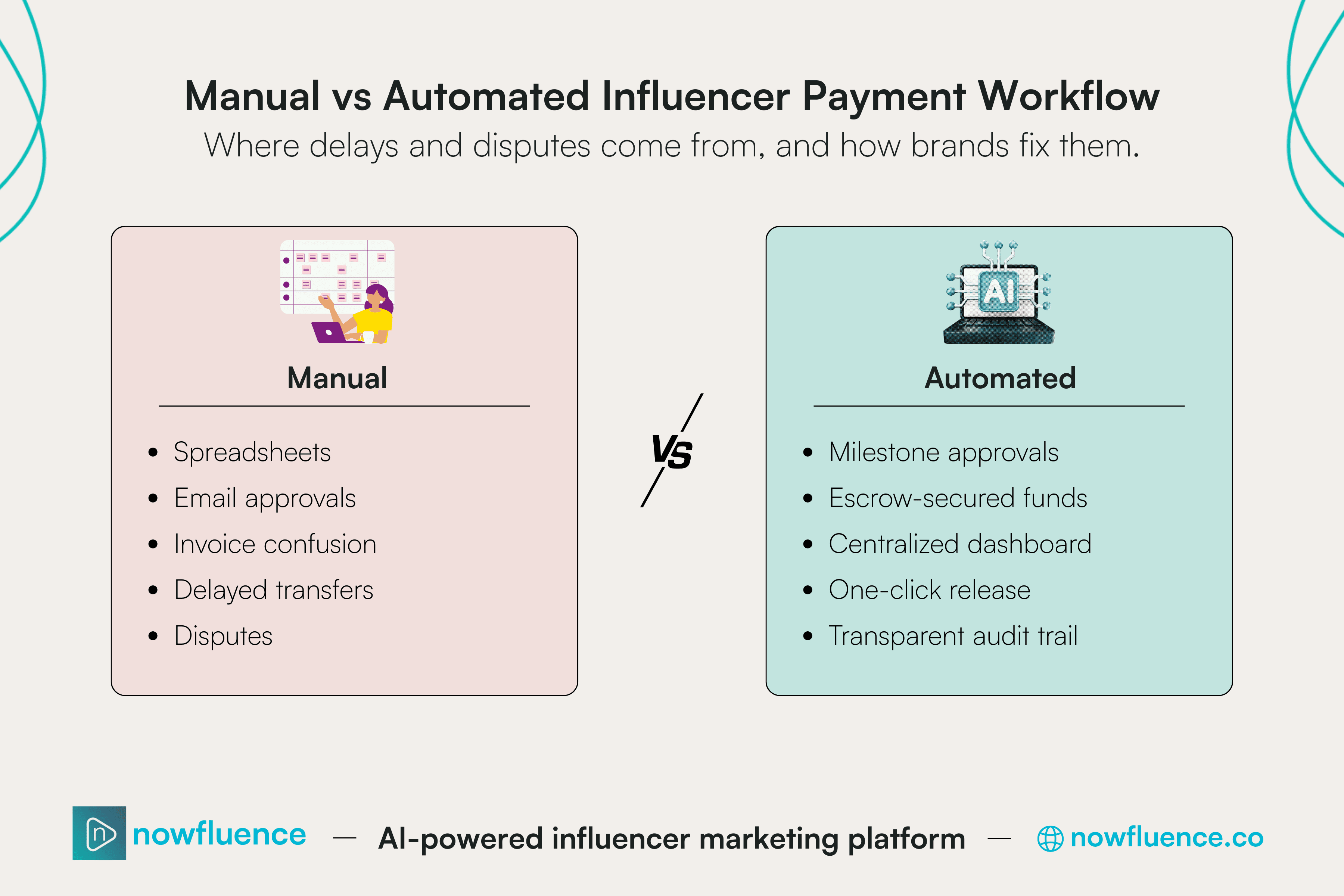
What a Modern Influencer Payment Workflow Looks Like
Brands that scale influencer marketing treat payments as infrastructure, not afterthoughts.
A modern influencer payment workflow includes:
1. Clear Deliverables Defined Upfront
All content requirements documented inside the campaign system.
2. Structured Milestone Approvals
Content approval triggers the next payment phase automatically.
3. Escrow-Secured Payments
Funds are reserved at campaign launch, protecting both brand and creator.
4. Centralized Campaign Dashboard
All deliverables, approvals, communication, and payments live in one system.
5. One-Click Payment Release
Once deliverables are approved, payment is released instantly, eliminating administrative delays.
This structure reduces ambiguity, prevents disputes, and creates predictable timelines.
How Automation Eliminates Delays and Disputes
With influencer payment automation, brands gain:
- Automatic reminders
- Approval-based payment triggers
- Secure escrow handling
- Full audit logs
- Transparent payout history
When connected to real-time performance tracking, such as direct Shopify attribution, brands can connect influencer performance to revenue in Shopify while maintaining payment clarity.
Operational infrastructure also allows brands to:
- Reduce payment risk in influencer marketing
- Scale influencer marketing without agencies
- Standardize influencer marketing operations across campaigns
When influencer marketing shifts from experimental to recurring, infrastructure becomes non-negotiable.
Turning Influencer Marketing Into Operational Infrastructure
Influencer marketing does not fail because of strategy.
It fails because of poor operational systems.
Manual influencer payment workflows create:
- Delays
- Administrative burden
- Escalating disputes
- Reputation damage
- Scaling bottlenecks
Structured systems introduce:
- Standardization
- Transparency
- Financial protection
- Predictability
As influencer budgets increase, brands that invest in operational infrastructure outperform those relying on spreadsheets and fragmented processes.
The future of influencer marketing isn’t just better discovery or attribution.
It’s better operations.
And payments are where operations either succeed, or collapse.
FAQ
How do brands pay influencers securely?
Brands use escrow-based systems, milestone approvals, and automated payout releases to ensure funds are protected and delivered only after approved work is completed.
What causes influencer payment disputes?
Most disputes arise from unclear deliverables, missing approval checkpoints, or delayed invoicing within unstructured influencer payment processes.
Should influencer payments be tied to performance?
In performance-driven campaigns, brands may structure influencer payment workflows around attribution milestones, especially when integrating directly with ecommerce platforms like Shopify.
Want to discuss insights from this study? Reach out to our research team.