Connecting Influencer Performance to Revenue in Shopify
Learn how Shopify brands connect influencer performance to real revenue using attribution models, analytics, and data-driven influencer marketing strategies.
February 06, 2026
Influencer marketing has evolved far beyond brand awareness. For Shopify brands, creators are no longer just a top-of-funnel channel, they are directly driving revenue. The challenge, however, is connecting influencer performance to actual sales in a way that is accurate, scalable, and actionable.
Many brands still rely on vanity metrics like likes, views, or engagement rates. While these signals can indicate reach, they fail to answer the most important question: how much revenue did this influencer actually generate?
Connecting influencer activity to revenue inside Shopify is what turns influencer marketing from an experiment into a true performance channel.
Why Influencer Performance Has Been Historically Hard to Measure
Influencer marketing measurement has always struggled with attribution. Social platforms sit outside the ecommerce stack, and influencer activity often happens days or weeks before a purchase.
Common challenges include:
- Influencer content driving demand without immediate conversion
- Multiple touchpoints before checkout
- Manual tracking via spreadsheets, links, and discount codes
- Attribution models that oversimplify buyer behavior
As influencer marketing scaled, these limitations became more visible, especially for Shopify brands that depend on clean revenue data to guide growth decisions.
Why Shopify Is Central to Influencer Revenue Attribution
Shopify changed the equation by becoming the system of record for ecommerce revenue.
Unlike social platforms, Shopify captures:
- Checkout events
- Order values
- Customer journeys
- Conversion timestamps
This makes Shopify the most reliable place to connect influencer activity to real business outcomes. According to Shopify’s own guidance on influencer marketing strategy, successful brands treat influencer marketing as a long-term growth channel, not a one-off campaign, which makes proper attribution even more critical.
Instead of asking “Did this post perform well?”, brands can now ask:
- How much revenue did this influencer drive?
- What was the ROI per creator?
- Which creators consistently outperform others?
How Brands Connect Influencer Activity to Revenue in Shopify
Attribution Models That Actually Work
There is no single perfect attribution model, but Shopify brands tend to rely on a combination of approaches:
Last-click attribution
Useful for simplicity, but often undervalues creators who drive consideration rather than direct conversions.
Discount codes and referral links
Helpful for direct tracking, but limited when customers don’t use them or convert later.
Multi-touch and predictive attribution
More advanced models account for multiple interactions and timing, providing a clearer picture of influencer impact across the funnel.
When influencer marketing becomes a recurring channel, predictive attribution models are often the only way to fairly measure performance across dozens or hundreds of creators.
The Limits of Manual Tracking
Many brands still rely on spreadsheets, UTM links, and manual reconciliation to track influencer performance. This approach works at small scale but breaks quickly as campaigns grow.
Manual tracking leads to:
- Inconsistent data
- Delayed insights
- Missed optimization opportunities
At scale, influencer marketing needs the same operational rigor as paid media, real-time data, clean attribution, and centralized reporting.
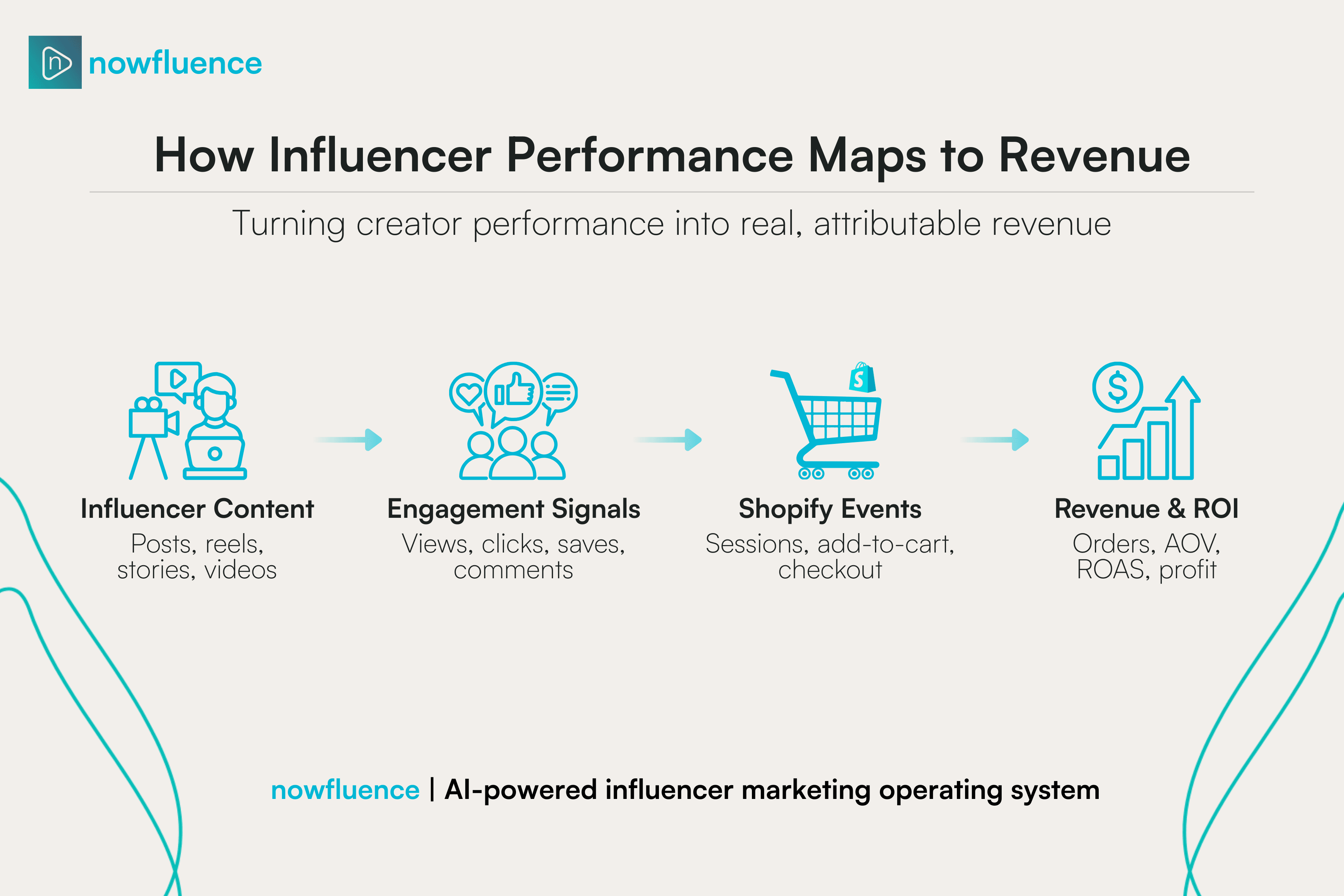
From Content to Checkout: What Real Performance Looks Like
True influencer performance goes beyond surface-level metrics. Shopify brands that connect influencer performance to revenue focus on KPIs such as:
- Revenue per influencer
- ROI per creator campaign
- Cost per acquisition (CPA)
- Conversion rate from influencer traffic
- Repeat purchase behavior influenced by creators
As highlighted by Forbes in its analysis of social commerce and the influencer effect, consumers increasingly discover products through creators before completing purchases elsewhere. This makes revenue-based measurement essential, not optional.
Influencer marketing performance lives at the intersection of content, trust, and commerce. Shopify is where those signals become measurable.
Scaling Influencer Marketing as a Revenue Channel
As influencer programs grow, brands face a clear choice: either treat influencer marketing as a creative experiment, or operate it like a performance channel.
Scaling successfully requires:
- Reliable attribution models
- Centralized analytics tied to Shopify revenue
- Automated workflows for campaigns and payouts
- Consistent benchmarks across creators
Industry guides, such as Influencer Marketing Hub’s overview of ecommerce influencer strategies, emphasize that influencer marketing performs best when it is structured, repeatable, and data-driven.
At scale, performance clarity is what allows brands to confidently increase investment.
Final Thoughts: Turning Influencer Marketing Into Measurable Growth
Connecting influencer performance to revenue in Shopify is no longer a “nice to have.” It’s the foundation for treating creator partnerships as a real growth lever.
When brands move beyond engagement metrics and focus on revenue attribution, influencer marketing becomes:
- Measurable
- Predictable
- Scalable
The future of influencer marketing belongs to brands that understand exactly how creator performance translates into revenue, and use that insight to grow smarter, not louder.
Want to discuss insights from this study? Reach out to our research team.