Influencer Marketing vs Affiliate Marketing for Shopify Brands
Influencer marketing and affiliate marketing both drive Shopify sales, but in very different ways. Learn which model delivers real ROI, better attribution, and scalable growth.
February 10, 2026
For Shopify brands operating in increasingly competitive eCommerce categories, performance marketing decisions directly impact revenue efficiency and long term growth. Among the most debated choices is where to allocate budget between influencer marketing and affiliate marketing.
While both models rely on third party creators to drive sales, they behave very differently when it comes to attribution, control, scalability, and brand value.
This article breaks down influencer marketing vs affiliate marketing for Shopify brands, helping teams understand which model drives sustainable growth and when combining both delivers the best results.
Understanding the Two Models in a Shopify Context
What Affiliate Marketing Looks Like on Shopify
Affiliate marketing is typically built around:
- Commission based payouts
- Affiliate links or discount codes
- Last click attribution models
For Shopify brands, affiliates often include bloggers, review sites, coupon platforms, and cashback communities.
The appeal is straightforward. Brands only pay when a sale occurs.
The challenge lies in attribution and incentives. Affiliate marketing tends to reward whoever captures the final click, not necessarily the partner who influenced the buying decision earlier in the journey. This often pushes affiliates toward discount driven behavior rather than meaningful product education or brand building.
What Influencer Marketing Looks Like on Shopify Today
Influencer marketing has evolved far beyond gifting and awareness campaigns.
Modern influencer marketing for Shopify includes:
- Paid partnerships
- Fixed rate campaigns
- Hybrid compensation models combining flat fees and performance
- Clear deliverables and timelines
Influencers operate higher in the funnel, driving product discovery, trust, social proof, and demand creation.
According to a recent Forbes analysis on how marketers choose influencer partners across TikTok and Instagram, brands are becoming far more intentional about structure, accountability, and measurable outcomes in influencer campaigns. This signals a clear shift away from purely awareness driven influencer strategies toward performance focused execution.
Attribution Is Where the Difference Becomes Clear
The most important distinction between influencer marketing vs affiliate marketing for Shopify brands shows up in attribution.
Affiliate Attribution: Simple but Often Misleading
Most affiliate programs rely on:
- Last click attribution
- Cookie based tracking
- Promo code validation
This setup disproportionately rewards bottom of funnel activity. Coupon sites and deal aggregators frequently capture credit for conversions that were influenced earlier by paid media, influencers, or email campaigns.
The result is revenue leakage, where brands pay commissions without generating incremental demand.
Influencer Attribution: More Complex but More Honest
Influencer attribution reflects how customers actually buy.
Influencers influence:
- Consideration
- Brand recall
- Trust
- Repeat purchases
When influencer performance is connected directly to Shopify data, brands can analyze revenue per creator, ROI per campaign, and assisted conversions, not just final clicks.
As influencer marketing becomes more data driven, brands increasingly rely on AI powered tools to evaluate creators, forecast expected performance, and connect campaigns directly to Shopify revenue.
Cost Structure and Risk Profile
Affiliate Marketing: Low Risk, Low Control
Affiliate marketing offers:
- Pay for performance economics
- Predictable margins
But it also comes with tradeoffs:
- Limited brand control
- Heavy reliance on discounts
- Minimal differentiation between partners
- Exposure to attribution gaming
Affiliate marketing works best as a conversion capture layer, not as a primary growth engine.
Influencer Marketing: Higher Investment, Higher Upside
Influencer marketing requires more upfront investment but offers significantly more upside.
Key advantages include:
- Strong brand alignment
- Creative control
- Trust driven conversions
- Long term audience value
When measured properly, influencer marketing becomes a repeatable and scalable performance channel rather than a one off experiment.
When Affiliate Marketing Makes Sense for Shopify Brands
Affiliate marketing is effective when:
- The brand already has strong demand
- Margins support ongoing commissions
- The goal is conversion efficiency rather than differentiation
It performs best in commoditized categories and price sensitive markets where purchase intent already exists.
When Influencer Marketing Wins
Influencer marketing outperforms affiliate marketing when:
- Trust plays a major role in the buying decision
- Products require education or demonstration
- Brands are building long term equity
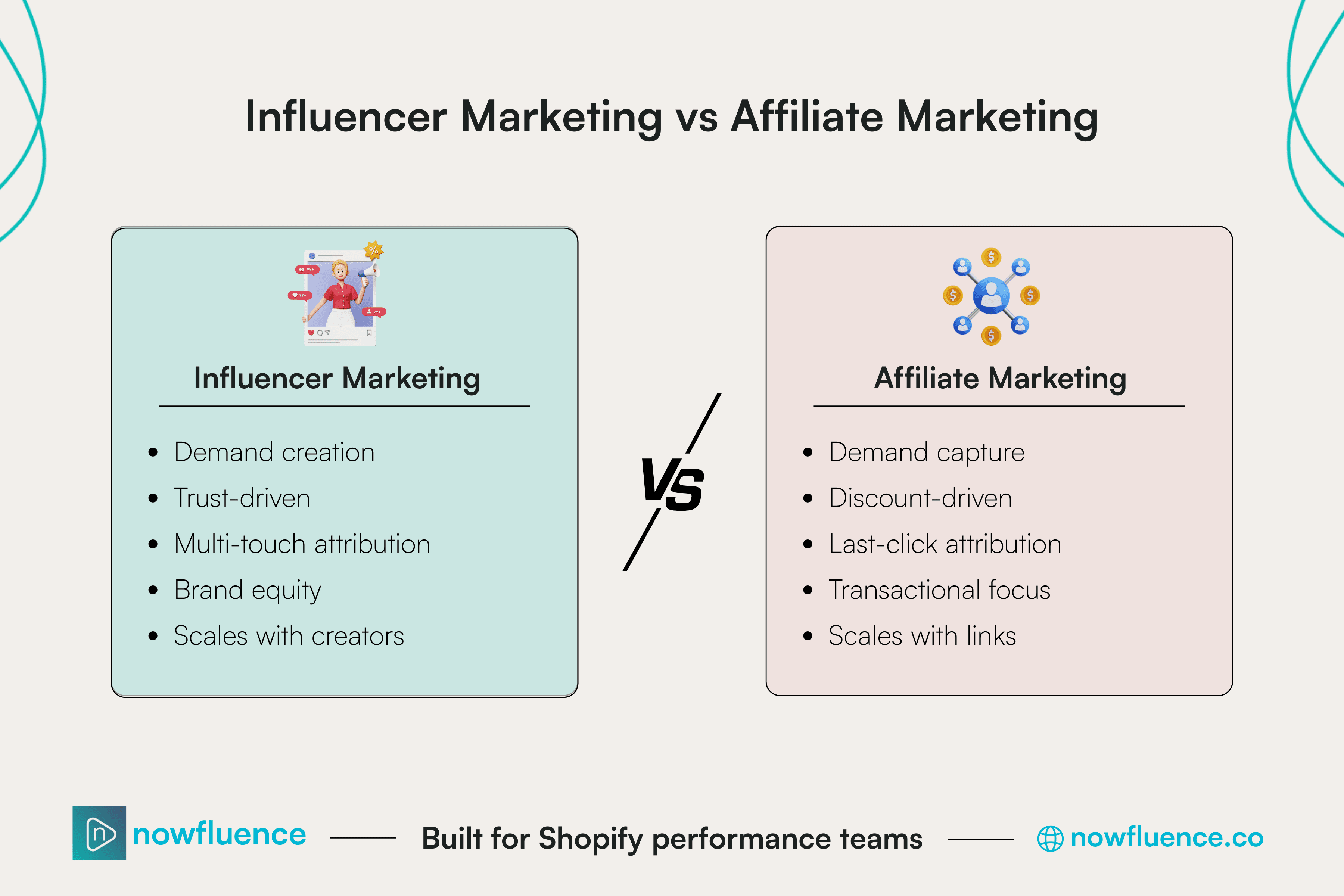
- Growth depends on demand creation, not just demand capture
For Shopify brands competing in crowded categories, influencer marketing often becomes the primary growth lever, with affiliates playing a supporting role.
The Most Effective Strategy Is Combining Both
High performing Shopify brands rarely choose one model exclusively.
Instead, they:
- Use influencers to create demand
- Use affiliates to capture demand
- Measure both against real Shopify revenue
This layered strategy prevents overpaying for conversions while maximizing incremental growth.
Where This Is Heading
As influencer marketing continues to professionalize through better data access, clearer pricing expectations, and improved attribution, the gap between influencer marketing and affiliate marketing will continue to widen.
Brands that treat influencers as performance partners, rather than awareness channels, gain a durable competitive advantage that affiliate only strategies cannot replicate.
For a deeper breakdown of how Shopify brands measure influencer ROI, explore our guide on influencer attribution models.
Want to discuss insights from this study? Reach out to our research team.