The Influencer Marketing Stack in 2026: From Discovery to Revenue
Discover how the influencer marketing stack will evolve by 2026, from AI powered creator discovery to attribution, infrastructure, and revenue driven performance.
December 29, 2025
Influencer marketing is no longer an experimental channel. By 2026, it is becoming a core revenue driver for modern commerce brands. Yet most teams are still operating with fragmented tools, manual workflows, and incomplete data.
What is missing is not more creators, content, or spend. What is missing is infrastructure.
As AI adoption accelerates across industries, influencer marketing is undergoing the same transformation seen in finance, logistics, and performance marketing. The future belongs to brands that treat influencer marketing as a full stack system rather than a collection of disconnected tactics.
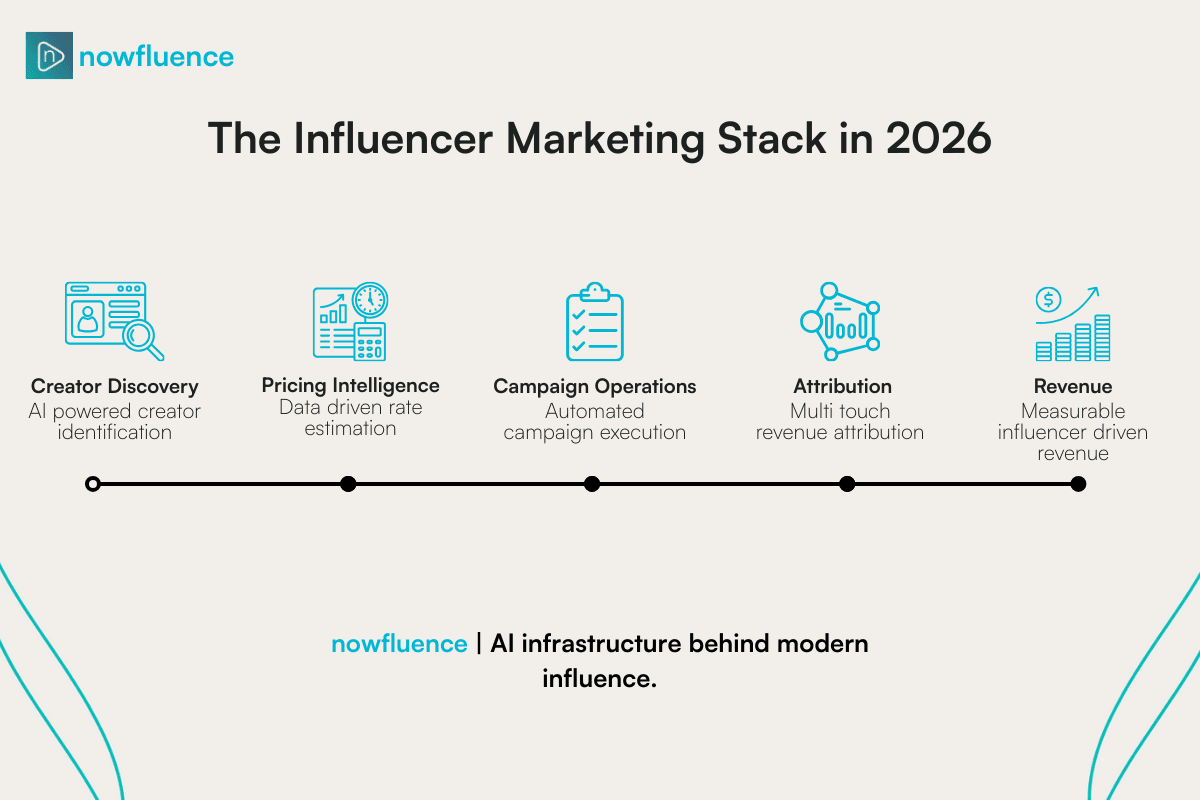
This article breaks down what the influencer marketing stack in 2026 looks like, how AI reshapes each layer, and why infrastructure is the defining competitive advantage for brands seeking predictable revenue from creator partnerships.
Why the Influencer Marketing Stack Needs to Evolve
Most influencer programs today are built on tools that were never designed for scale or performance accountability. Discovery tools sit in one place. Campaign management happens in spreadsheets. Attribution lives somewhere else. Payments are handled manually.
According to McKinsey’s latest research on AI adoption, most companies are already using AI in some form, but only a small percentage are achieving measurable business impact. The gap is not experimentation. The gap is operational integration.
Influencer marketing faces the same challenge.
Without an integrated influencer marketing infrastructure, brands cannot answer basic questions such as which creators drive real revenue, how performance compounds over time, or how to forecast outcomes before a campaign launches.
The influencer marketing stack of 2026 closes this gap by connecting discovery, execution, attribution, and payouts into a single system of record.
Layer 1: AI Powered Creator Discovery at Internet Scale]
In 2026, creator discovery is no longer about searching manually through platforms or relying on inbound creator applications. It is about AI driven analysis of the entire creator economy.
The modern influencer marketing stack begins with AI that continuously analyzes public creator data across Instagram, TikTok, and YouTube at massive scale. This includes engagement patterns, audience quality, content performance, historical brand collaborations, and monetization signals.
MIT Sloan emphasizes that modern digital transformation is no longer about digitizing workflows. It is about extracting intelligence from data to drive better decisions. In influencer marketing, this means discovery systems that do more than surface profiles. They surface predictions.
AI powered discovery enables brands to identify creators who are most likely to convert, not just those with the largest reach. This shift directly supports a performance driven mindset explored in the nowfluence article What Makes a High Performing Influencer in 2026? The Traits That Drive Real Sales, which highlights why influence must be evaluated through outcomes rather than vanity metrics.
Layer 2: Predictive Pricing and Deal Intelligence
Once creators are identified, the next challenge is negotiation friction.
By 2026, influencer marketing software will rely on AI to estimate expected creator rates using real performance data rather than guesswork. Pricing intelligence becomes a core layer of the influencer marketing stack.
This capability shortens negotiation cycles, reduces overpayment risk, and allows brands to move from discovery to deal execution faster. McKinsey’s research shows that organizations creating the most value from AI embed intelligence directly into workflows rather than treating it as a standalone tool.
Predictive pricing also supports better forecasting, a theme previously explored in The Influencer Success Forecast: Predicting Sales Before Launch, where campaign outcomes can be estimated before spend is committed.
Layer 3: Workflow Automation and Influencer Operations
Influencer marketing does not fail because of creativity. It fails because of operations.
Deliverables get delayed. Approvals stall. Communication breaks down. Payments become a bottleneck. As campaigns scale, operational debt compounds quickly.
The influencer marketing stack of 2026 includes a dedicated Influencer Operations layer that automates workflows end to end. This includes deliverables tracking, approvals, contract logic, and payout readiness.
MIT Sloan’s research highlights that successful digital transformation requires redesigning how humans interact with systems. In influencer marketing, this means removing manual coordination so teams can focus on strategy rather than administration.
This operational layer is the foundation of what was explored in Influencer Operations: The Missing Layer in Modern Marketing Teams, reinforcing why infrastructure is essential for scaling creator partnerships.
Layer 4: AI Attribution and Revenue Measurement
Attribution is where influencer marketing becomes a revenue channel or remains guesswork.
By 2026, last click attribution is no longer sufficient. Modern influencer marketing infrastructure relies on multi touch attribution models that connect creator exposure to downstream conversions across time.
Direct integrations with commerce platforms such as Shopify enable real time visibility into sales, order value, and ROI per creator without storing sensitive customer data. This aligns with OECD principles around responsible AI and data governance, emphasizing transparency and trust.
AI attribution transforms influencer marketing from a branding exercise into a measurable performance channel. This evolution builds on concepts discussed in Multi Touch Influence: AI Attribution Beyond Last Click, showing how influence compounds across touchpoints rather than converting in isolation.
Layer 5: Secure Payments and Financial Trust
Payments are often the final friction point in influencer marketing.
The influencer marketing stack of 2026 integrates secure escrow based payouts directly into campaign workflows. Funds are released only when deliverables are approved, protecting both brands and creators.
This approach reduces payment risk, increases trust, and aligns incentives across all parties. It reflects a broader trend highlighted by OECD research, where trust, accountability, and governance are becoming central to AI driven systems.
When financial infrastructure is embedded into the influencer marketing stack, partnerships become repeatable rather than transactional.
Why Infrastructure Is the Competitive Advantage
McKinsey’s State of AI makes one insight clear. Technology alone does not create value. Systems do.
The future of influencer marketing belongs to brands that invest in influencer marketing infrastructure, not just influencer marketing tactics. Those who adopt a full stack approach gain faster execution, clearer attribution, lower risk, and predictable revenue outcomes.
Influencer marketing software in 2026 is not a dashboard. It is an operating system.
Final Thoughts
Influencer marketing is entering its infrastructure era.
As AI becomes deeply embedded into how creators are discovered, campaigns are executed, and revenue is measured, the brands that win will be those that move first from fragmented tools to unified systems.
The influencer marketing stack of 2026 connects discovery to revenue in a single flow, transforming influence into a scalable performance channel rather than an experiment.
For brands, agencies, and creators alike, the question is no longer whether influencer marketing works. The question is whether the right infrastructure is in place to make it work consistently.
Want to discuss insights from this study? Reach out to our research team.