Compliance in Influencer Marketing: What Brands Must Track
Learn what brands must track to stay compliant in influencer marketing, including FTC disclosure rules, EU consumer law, and pricing transparency.
January 02, 2026
Influencer marketing has matured from an experimental channel into a core revenue driver for modern brands. As budgets increase and performance expectations rise, so does regulatory scrutiny. Today, influencer marketing compliance is no longer optional. It is a fundamental operational requirement.
Brands that fail to track disclosures, pricing accuracy, and consumer transparency expose themselves to legal risk, platform penalties, and loss of consumer trust. This article breaks down what brands must actively track to remain compliant, using official guidance from the FTC in the United States, the European Commission, and the UK Advertising Standards Authority.
Why Influencer Marketing Compliance Matters
Regulators around the world now treat influencer marketing as advertising, not personal opinion. That distinction carries legal consequences.
From the FTC in the US to consumer protection authorities in the EU and UK, the message is consistent. If content influences purchasing decisions, it must be transparent, accurate, and not misleading.
For brands, this means compliance cannot be outsourced entirely to creators or agencies. It must be embedded into campaign operations, approvals, and reporting.
FTC Influencer Guidelines: What Brands Must Enforce
The US Federal Trade Commission provides clear rules under its influencer disclosure framework. According to the FTC, any material connection between a brand and an influencer must be disclosed.
A material connection includes payments, gifted products, free trips, discounts, or any benefit that could affect how an endorsement is perceived.
Key compliance requirements brands must track include:
Disclosures must be clear and conspicuous
They must be easy to notice and understand. Ambiguous hashtags or disclosures hidden at the end of captions do not meet FTC standards.
Disclosures must be placed close to the endorsement
They cannot be buried in a bio, a separate page, or after a long block of text.
Brands share responsibility
While influencers are directly responsible for disclosures, the FTC has repeatedly stated that brands must monitor and enforce compliance.
This is especially relevant when scaling influencer programs. As discussed in Influencer Operations: The Missing Layer in Modern Marketing Teams, compliance becomes exponentially harder when campaigns rely on manual tracking or spreadsheets.
Influencer Disclosure Rules Under EU Consumer Protection Law
In the European Union, influencer marketing falls under broader consumer protection law. Influencers are often legally considered traders when they promote products commercially.
EU regulations require that commercial intent is clearly identifiable. Consumers must be able to instantly recognize when content is advertising.
For brands operating globally, this introduces additional layers of compliance:
Clear identification of advertising
Sponsored content must be labeled in a way that is immediately understandable to consumers in each local market.
Truthful and non misleading claims
Product benefits, pricing, and performance claims made by influencers are subject to the same standards as traditional advertising.
Shared liability
Brands may be held accountable if influencers mislead consumers, even unintentionally.
This reinforces why influencer marketing must be treated as a revenue channel with governance, not an informal creator partnership program. Brands already investing in Influencer Marketing as a Revenue Channel for Shopify Brands must apply the same compliance rigor used in paid media.
Pricing Transparency and VAT Compliance in Influencer Content
Compliance does not stop at disclosures. Pricing claims are another common risk area, especially in performance driven influencer campaigns.
The UK Advertising Standards Authority makes it clear that pricing shown in ads must be accurate and transparent. If VAT is applicable, it must be included in the advertised price when targeting consumers.
Key issues brands must track include:
VAT inclusion
If an influencer promotes a price to consumers, that price should include VAT unless clearly stated otherwise.
Clear audience targeting
Prices shown without VAT should only appear in content explicitly targeting businesses.
Consistency between influencer content and checkout
Discrepancies between promoted prices and actual checkout pricing can be considered misleading advertising.
For Shopify brands running influencer campaigns tied directly to sales, this is especially critical. As explored in Why Every Shopify Brand Needs an AI Attribution Layer, performance tracking must align with compliance and consumer protection standards.
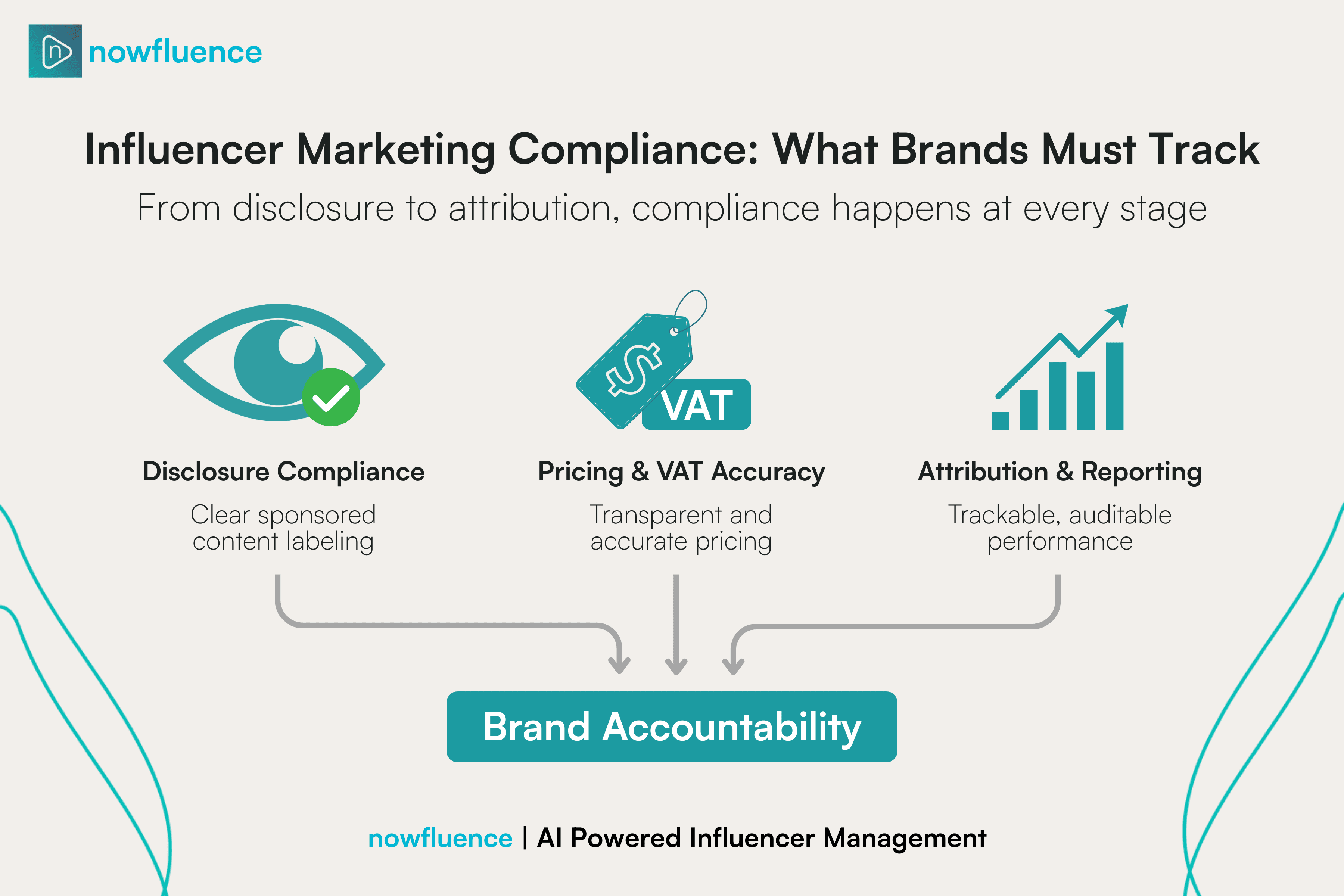
What Brands Must Actively Track in Influencer Campaigns
To remain compliant at scale, brands should track the following across every influencer campaign:
Disclosure presence and placement
Approval workflows that verify disclosures before content goes live.
Pricing accuracy
Verification that promoted prices match live offers and comply with regional tax rules.
Geographic compliance
Different disclosure language or pricing rules depending on audience location.
Audit trails
Proof of approvals, disclosures, and payments in case of regulatory review.
Payment governance
Clear linkage between approved deliverables and payouts, reducing risk on both sides.
Brands relying on manual processes often struggle here. This is why compliance increasingly overlaps with infrastructure and automation rather than legal checklists.
Compliance as a Competitive Advantage
Compliance is often framed as a cost or constraint. In reality, it is a competitive advantage.
Transparent influencer campaigns build trust with consumers, reduce legal risk, and create cleaner data for attribution and ROI analysis. Brands that track compliance effectively move faster because they spend less time fixing mistakes and reacting to enforcement issues.
In the next phase of influencer marketing, the brands that win will be the ones treating compliance as part of their operating system, not an afterthought.
Influencer marketing is no longer the Wild West. Brands that want predictable growth must build compliant, measurable, and scalable creator programs from day one.
Want to discuss insights from this study? Reach out to our research team.