How Often Should Brands Run Influencer Campaigns?
Learn the ideal influencer campaign frequency and why always-on influencer marketing drives better long-term ROI.
January 05, 2026
Influencer marketing has matured far beyond one off campaigns and experimental activations. Today, brands are no longer asking whether influencer marketing works. They are asking how often they should run influencer campaigns to drive consistent and measurable results.
Campaign frequency is now a strategic decision tied directly to revenue, attribution, and long term brand performance. Running campaigns too sporadically can limit impact. Running them without structure can create inefficiencies. This article breaks down how often brands should run influencer campaigns and why always on influencer marketing is becoming the dominant strategy.
Why Influencer Campaign Frequency Matters
Influencer marketing works through repeated exposure, trust building, and social proof. Unlike paid ads, the impact of creator content compounds over time rather than delivering instant results only.
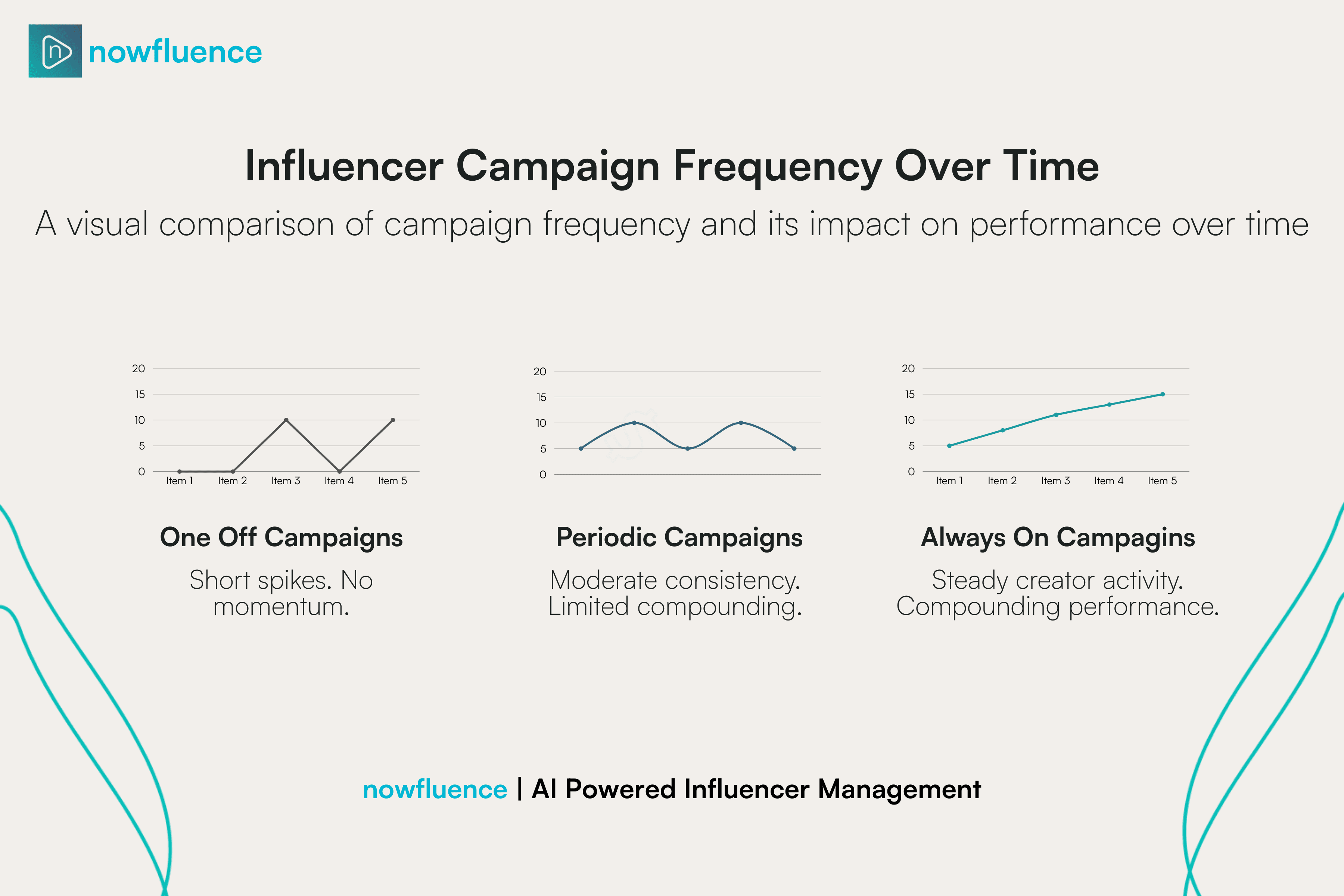
When brands run influencer campaigns inconsistently, they lose momentum. Audiences forget the message, attribution becomes fragmented, and creators lack continuity with the brand narrative.
Recent research and industry data show that influencer marketing performs best when campaigns are planned as an ongoing system rather than isolated launches. Campaign frequency directly affects brand recall, purchase intent, and long term return on investment.
This shift mirrors what we already see in other performance channels. Brands do not turn paid ads on and off every few months. Influencer marketing should follow the same logic.
Campaign Based vs Always On Influencer Marketing
Traditional influencer marketing relied heavily on campaign based execution. Brands launched a product, hired creators for a short period, and then went silent until the next initiative.
Always on influencer marketing flips that model.
Instead of sporadic bursts, brands maintain continuous creator partnerships throughout the year. This approach allows brands to test, learn, optimize, and scale based on real performance data rather than assumptions.
Data driven industry analysis shows that brands running ongoing influencer programs benefit from stronger creator brand fit, reduced negotiation time, and more predictable results. Continuous programs also allow content to stack across channels and attribution windows.
Always on influencer marketing is not about posting every day. It is about maintaining a consistent presence with the right creators over time.
What the Data Says About Frequency
Academic research on influencer post frequency provides important clarity. A recent peer reviewed study on the short and long term effects of influencer sponsored post frequency found that higher frequency does not automatically lead to increased audience skepticism when the same creator promotes the same brand consistently.
More importantly, the study revealed that purchase intention increased over time even when brand attitude remained stable. This supports the idea that influencer marketing delivers delayed impact rather than immediate conversion only.
In practical terms, this means that brands benefit from sustained exposure rather than one time campaigns. Short term metrics alone do not capture the full value of influencer marketing. Long term performance matters.
Industry data also supports this. Brands running monthly or continuous influencer activations consistently outperform those relying on quarterly or seasonal campaigns.
How Often Should Brands Run Influencer Campaigns?
There is no single number that applies to every brand. However, successful influencer programs follow a few clear patterns.
For growing ecommerce brands, influencer campaigns should run continuously with structured monthly cycles. This allows brands to test creators, formats, and messaging while feeding performance data back into the system.
For established brands, influencer marketing should operate as an always on channel with regular creator drops aligned to product launches, promotions, and seasonal demand.
Instead of asking how many campaigns to run, brands should ask how to maintain consistent creator activity that supports long term revenue goals.
This is where influencer operations and attribution become critical. Without clear workflows and performance tracking, campaign frequency becomes guesswork rather than strategy.
For a deeper look at how operational structure supports scalable influencer programs, see Influencer Operations: The Missing Layer in Modern Marketing Teams.
Why Always On Programs Drive Better ROI
Always on influencer marketing creates compounding advantages over time.
Creators become more authentic advocates rather than one time promoters. Audiences recognize the brand more frequently in trusted contexts. Brands reduce onboarding friction and negotiation cycles.
From a measurement perspective, ongoing programs make attribution clearer. Patterns emerge across creators, content formats, and time windows.
This is especially powerful for Shopify brands, where influencer driven sales often occur days or weeks after content goes live. Continuous programs allow brands to capture that delayed impact rather than attributing success to last click channels only.
To understand how attribution fits into this model, reference Multi Touch Influence: AI Attribution Beyond Last Click.
Operationalizing Campaign Frequency at Scale
Running frequent influencer campaigns manually does not scale. Spreadsheets, email threads, and disconnected tools slow execution and obscure performance.
Modern influencer marketing requires an operating system that supports continuous discovery, pricing intelligence, performance tracking, and automated payouts.
Platforms built for influencer operations allow brands to run always on programs without increasing overhead. This is the foundation that turns influencer marketing into a repeatable growth channel rather than a creative experiment.
For a broader view of how these systems connect from discovery to revenue, explore The Influencer Marketing Stack in 2026: From Discovery to Revenue.
Final Takeaway
Brands should stop treating influencer marketing as a seasonal tactic and start treating it as a performance channel.
The most effective influencer marketing strategies are built around consistent execution, long term creator relationships, and data driven optimization. Always on influencer marketing is not about volume. It is about continuity, measurement, and scalability.
The brands winning with influencer marketing are not asking how often they should run campaigns. They are building systems that allow influencer marketing to run continuously and predictably.
When frequency is powered by strategy, operations, and attribution, influencer marketing stops being guesswork and starts driving real revenue.
Want to discuss insights from this study? Reach out to our research team.