The Hidden Cost of Non-Verified Metrics: Why Brands Are Losing Money
Discover how fake followers, inflated engagement and non-verified metrics drain marketing budgets, and how AI attribution solves the problem.
December 08, 2025
Influencer marketing is now a 32.55 billion dollar industry projected for 2025, according to Statista. But while budgets continue to rise, so do the hidden losses caused by non-verified metrics. Behind the glossy dashboards and inflated engagement numbers, a financial problem is quietly eroding ROI for brands: fake data.
This issue is far from marginal. Research cited by Forbes reveals that 49 percent of Instagram influencers participated in follower fraud in 2021. IMAI’s analysis of 130 million accounts found that one in four influencers purchased at least 15 percent of their followers and three in four bought more than ten thousand followers. CreatorTag also reports that brands lose millions every year to fake engagement, emphasizing how bot-driven likes, comments and views create a false perception of performance while delivering zero commercial impact.
For brands investing heavily in creators, this is not a small operational issue. It is a direct drain on marketing dollars and a structural barrier to achieving performance commerce. Non-verified metrics turn influencer marketing into guesswork. Verified data turns it into predictable growth.
The financial impact of fake metrics
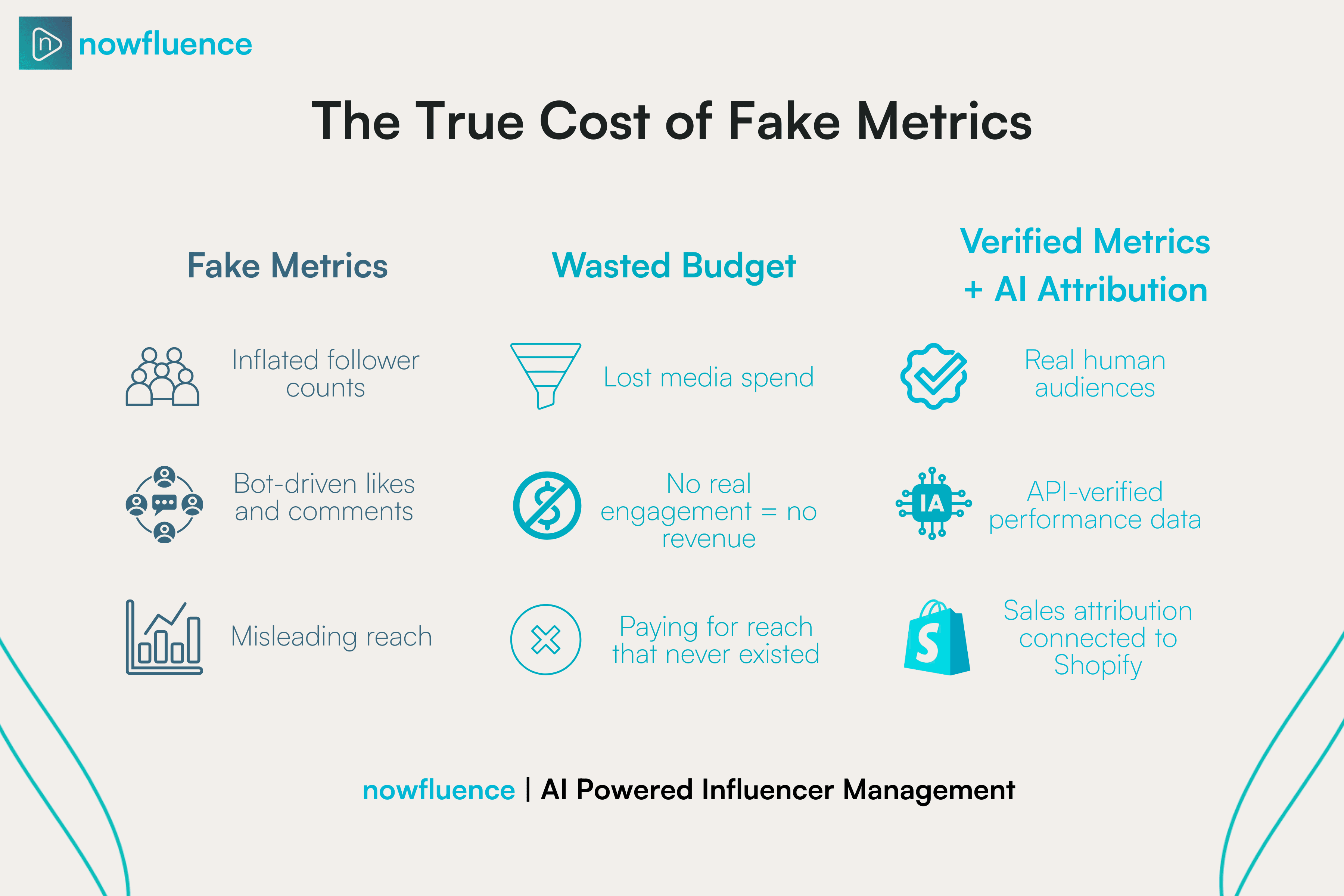
The first hidden cost is wasted spend. When a creator’s audience is inflated with bots, every metric the brand uses to forecast performance becomes unreliable. Reach is distorted. Engagement looks promising but has no connection to real human behavior. Click-through rates appear healthy but have no path to revenue.
This leads to two major financial consequences.
The brand pays creators whose real audience is significantly smaller than advertised. The media cost becomes inflated, often by 20 to 50 percent depending on the level of follower manipulation.
The brand receives little to no return because fake followers cannot convert, cannot purchase and cannot generate revenue.
This is where attribution becomes critical. As explored in our article Why Every Shopify Brand Needs an AI Attribution Layer, the only way to identify true ROI is by linking creator content directly to Shopify sales. Without verification and attribution combined, even sophisticated brands are still making decisions in the dark.
The operational cost of misaligned decisions
Fake metrics do not only impact budgets. They distort the entire decision-making cycle. Brands end up prioritizing creators based on inflated engagement rather than real influence. Campaign performance benchmarking becomes inaccurate. Forecasting models break. Audience analysis becomes unreliable. Creative strategy drifts away from reality.
This misalignment compounds over time, affecting not just one campaign but the entire influencer program. Teams waste hours investigating suspicious results. Agencies spend days manually auditing accounts. Leadership loses trust in creator investments. All because of metrics that were never real in the first place.
In our article The Creator Data Revolution: Why Verified Metrics Are the New Currency of Trust, we emphasized that data authenticity is now a prerequisite for operational excellence. The industry is shifting from impressions to truth. From aesthetics to accuracy. From vanity metrics to commerce outcomes.
The reputational cost brands rarely consider
There is also a reputational risk when brands repeatedly partner with creators who rely on fake engagement. Consumers perceive poor performance. Internal stakeholders question the investment. Competitors outperform simply because they work with verified data.
CreatorTag’s analysis highlights another overlooked dimension: algorithmic reputational damage. When brands collaborate with creators who artificially inflate engagement, platforms often deprioritize the content because bot activity signals low-quality posting. This means brands not only waste budget but also lose organic reach opportunities.
As detailed in What Makes a High Performing Influencer in 2026, the future belongs to creators with real audiences, real engagement and real sales impact. Verified metrics separate professionals from performers. They redefine what “influence” actually means.
The solution: verified metrics and AI attribution
The industry no longer needs to accept fraudulent data as a cost of doing business. New infrastructure layers are emerging to eliminate the problem. API-verified metrics through AI ensure that follower counts, engagement and audience demographics are authentic. AI attribution layers connect creator content to real conversions. Combined, these systems allow brands to move from speculation to certainty.
With verified metrics brands can accurately forecast performance before launching a campaign. With AI attribution brands can identify which creators truly drive revenue. With both working together influencer marketing becomes a predictable, scalable and measurable growth channel.
This is the foundation of performance commerce and the operating system nowfluence is building for the next generation of influencer marketing.
Final thought
Non-verified metrics are not a harmless flaw. They are a financial liability. The brands that win in the next era of influencer marketing will be the ones that operate with verified data, AI attribution and complete transparency. Influence only works when the numbers are real and the revenue is measurable.
Want to discuss insights from this study? Reach out to our research team.